

Insurance Claims
Collapse
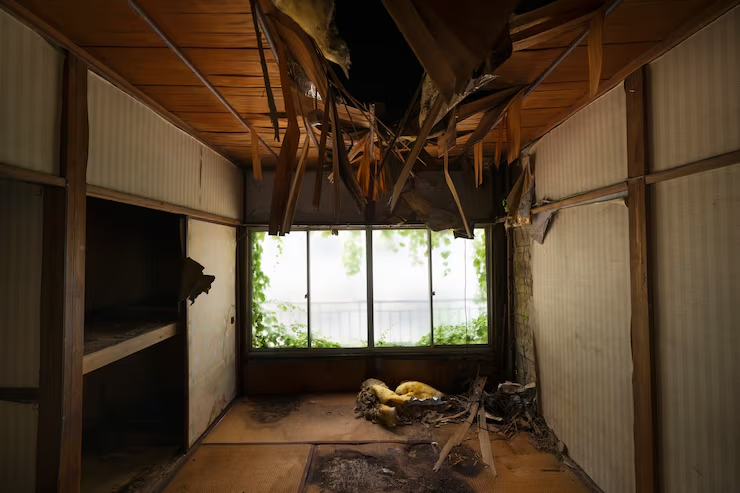
Structural collapse — whether sudden or the result of a covered peril — often leads to significant disputes about coverage. Insurers frequently argue that collapse resulted from deterioration or faulty construction rather than a covered cause, denying claims that policyholders reasonably expected to be covered.


.png)

The situation
What typically happens with collapse claims
Collapse coverage varies significantly between policies. Some policies cover only sudden, complete collapse, while others extend to imminent collapse or substantial structural impairment. Insurers routinely dispute whether a given condition qualifies as a covered collapse, arguing that partial structural failure, foundation settlement, or hidden decay falls outside coverage. The definition of collapse in a policy is frequently litigated.
The situation
What typically happens with collapse claims
Collapse coverage varies significantly between policies. Some policies cover only sudden, complete collapse, while others extend to imminent collapse or substantial structural impairment. Insurers routinely dispute whether a given condition qualifies as a covered collapse, arguing that partial structural failure, foundation settlement, or hidden decay falls outside coverage. The definition of collapse in a policy is frequently litigated.

Common obstacles
Why these claims are often disputed
Insurance companies employ experienced adjusters whose role is to limit payouts. Knowing where disputes typically arise gives policyholders a real advantage.
Many policies define collapse narrowly, and insurers use that language to exclude partial failures, settling foundations, and structural impairment.
What to know
Collapse coverage depends heavily on the exact policy wording. Definitions may distinguish complete collapse, abrupt falling or caving in, substantial structural impairment, and conditions involving hidden decay or specified causes.
Insurers may deny collapse claims by attributing the failure to long-term decay or deterioration that they claim should have been detected and corrected.
What to know
Whether deterioration was concealed and reasonably discoverable may affect the coverage analysis. Engineering findings, inspection history, and photographs can help show when the condition became apparent and why the failure occurred.
When collapse results from a covered peril such as weight of snow, ice, or hidden insect damage, insurers may still contest whether the cause qualifies for coverage.
What to know
Structural failure may involve several contributing conditions. An engineer can help document the sequence of events and determine whether snow load, ice, hidden decay, insects, water, or another covered cause materially contributed.


Analyze the policy collapse provisions
We review how your policy defines collapse and identify arguments for why the loss qualifies under that definition.

Document the structural failure
We work with engineering and construction experts to document the nature, cause, and full extent of the collapse.

Challenge deterioration defenses
We present the evidence to the insurer and challenge unsupported arguments involving hidden decay, faulty construction, or ordinary deterioration.

Pursue recovery through negotiation and litigation
We present the case for coverage and pursue litigation when the insurer refuses to pay.

Questions
Common questions about collapse claims
These answers are general. Contact us for guidance specific to your situation.
My insurer says what happened is not a covered collapse because the structure didn't completely fall down. Is that right?
.svg)
The insurer says my foundation problem is not collapse. What are my options?
My roof collapsed under snow load. Is that covered?

Types of claims we handle
Every type of property loss, covered.
We handle every type of covered building and personal property loss that may affect your home or business.


Ready to start the process?
Share the basic details of your situation. The firm will review the information and explain the appropriate next steps.

.png)

